Stop thinking like a construction worker gathering bricks. Start thinking like an architect designing the blueprint for your IB Psychology IA.

The Definitive Guide to the IB Psychology IA
Research Proposal – First Assessment 2027 • Our Step-by-Step Blueprint to Scoring 24/24
1. Welcome – Let Us Clear the Air Immediately
Welcome to the definitive guide to the IB Psychology IA, crafted by the team at IB Psychology Academy.
If you are panicking about your IB Psychology IA, take a deep breath. We are going to teach you exactly how to crack this. The biggest misconception students have about the new 2027 syllabus is that you need to run a massive, complicated experiment with real participants and complex statistics.
That is completely wrong.
Your task is to write a Research Proposal for your IB Psychology IA. Think of yourself as an architect presenting a building plan to a client. You do not need to build the building—you need to prove that your design is intelligent, ethical, and practical.
Let us walk you through exactly how to do that, section by section.
Stop thinking like a construction worker who gathers bricks (data). Start thinking like an architect who designs the blueprint (logic and justification). Examiners do not mark your ability to collect data; they mark your ability to justify every single decision you make on paper in your IB Psychology IA.

2. Your 5-Step Roadmap For IB Psychology IA
Let us give you the bird’s-eye view first. Here is how we will spend your 20 teaching hours on your IB Psychology IA. We use this roadmap with every single one of our students at IB Psychology Academy to keep them from getting lost.
| Phase | What You Actually Do |
|---|---|
| Topic & Context | Pick a real-world context (e.g., Digital Technology, Human Development). Choose your approach (Biological, Cognitive, or Sociocultural). (3 hrs) |
| Research Question | Narrow your broad topic down to a laser-focused, proposal-style RQ. (2 hrs) |
| Methodology Selection | Decide which of the 4 methods fits your RQ: Experiment, Interview, Focus Group, or Observation. (3 hrs) |
| Draft the Proposal | Write the background, procedure, ethics, and limitations. (8 hrs) |
| Final Polish | Edit ruthlessly for clarity and check the 2,200-word limit. (4 hrs) |
3. Official IB Psychology IA Rubric Decoded
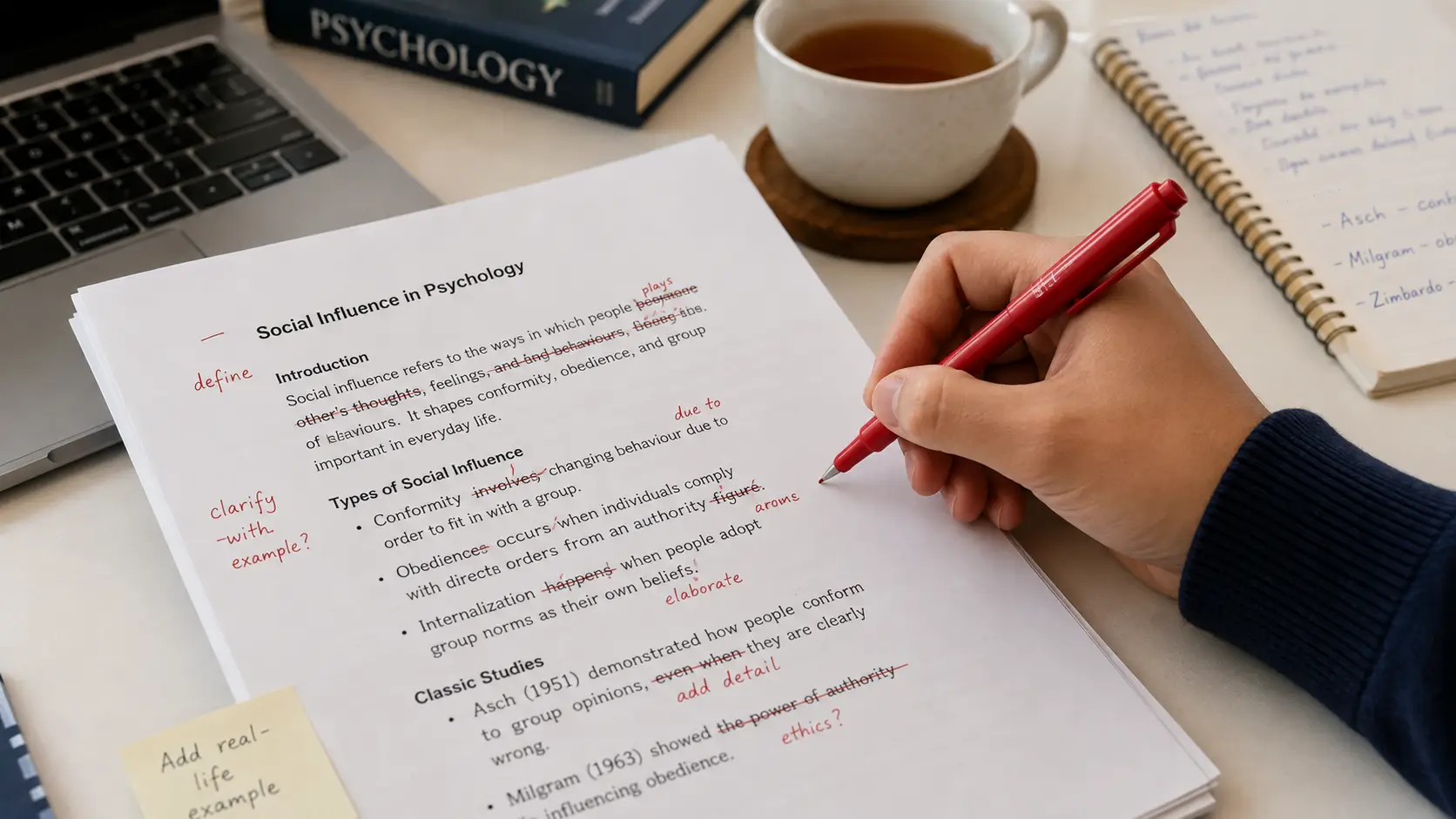
Forget the vague IB objectives. Let us tell you exactly what the examiner ticks off on their sheet. We are breaking down the four criteria of the IB Psychology IA rubric so you know precisely where to fight for every mark.
Criterion A: Introduction (6 marks)
What they check: Your research question, relevant background theory, and the rationale (the “why”).
Our team’s secret: You do not just state the theory. You must show why testing this specific theory on this specific population (e.g., “urban teenagers”) is a gap in current research.
When you read your background research for your IB Psychology IA, constantly ask yourself: “What is the missing piece in this puzzle?” Has this theory been tested on adults but never on digital-native teenagers? Has it been tested in labs but never in a school cafeteria? Pointing out that specific missing piece is how you get a 6/6 in Criterion A.
Criterion B: Research Methodology (6 marks)
What they check: Your chosen method, design, and participant sampling strategy.
Our team’s secret: Justifying your choice is worth more than the choice itself. If you pick an interview, tell us why a questionnaire would not work.
The IB Psychology IA framework requires you to select one method from the four practiced in your class practicals—this is an internal assessment requirement rooted in the course curriculum, not a Paper 2 assessment. While these methods also appear in Paper 2, Section A (where you answer questions about your practicals), your IB Psychology IA proposal stands independently as a research design task.
Criterion C: Data Collection (6 marks)
What they check: Your step-by-step procedure, materials, and ethical considerations.
Our team’s secret: Your ethics must be tailored to your specific study. Do not just write “informed consent.” Write how you will obtain it, what you will say in the debrief, and how you will anonymize the specific data you collect.
If your grandmother would not feel comfortable reading your consent form and knowing exactly what she is signing up for, you have failed in ethics. Write your ethics section so clearly that a stranger understands exactly what they are walking into.
Criterion D: Discussion (6 marks)
What they check: Forward-looking evaluation—anticipated outcomes, methodological limitations, and wider implications.
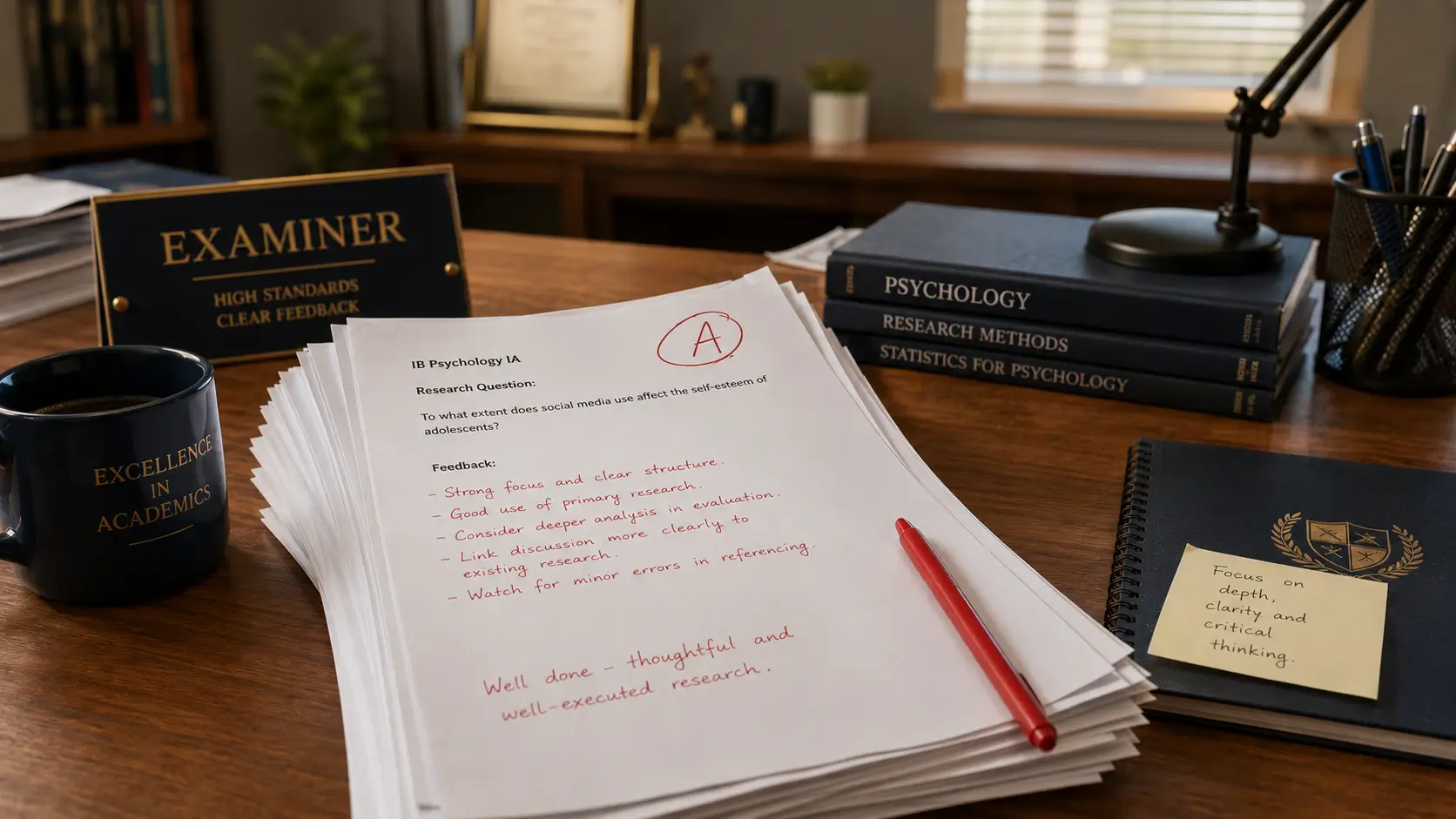
Our team’s secret: Because you have no actual data, the examiner wants to see you critique your design before it happens. Be ruthlessly honest about your study’s weaknesses.
Look at your proposed IB Psychology IA study through these three intellectual lenses for a 6/6 in Discussion:
- Internal Lens: Am I actually measuring what I claim to measure?
- External Lens: Can this apply beyond my small group?
- Procedural Lens: Is my design fundamentally flawed?
4. The Hard Stop: The 2,200-IB Psychology IA Word Limit
Read this carefully: The official IB examiner will not read one single word beyond 2,200 words in your IB Psychology IA proposal.
If your proposal is 2,300 words, the final 100 words—which could contain your best evaluation points—are entirely ignored. Treat this as an unbreakable law.
Pretend you are a surgeon amputating dead tissue. If a sentence does not directly serve your research justification or methodological clarity, cut it. No mercy. Every sentence must either (a) justify your RQ, (b) explain your method, or (c) evaluate your design.
5. Choosing Your Weapon: The 4 Research Methods
Based on the course curriculum and the internal assessment requirements, your IB Psychology IA proposal must use one of the four research methods you practiced during your class practicals—specifically Experiment, Interview, Focus Group, or Observation.
While these methods are also assessed in Paper 2, Section A (where you answer questions about your class practicals), your IB Psychology IA requires you to select one of these methods and justify its use for investigating your specific research question.
Here is how to pick the right one for your RQ:
- Experiment: Best for measuring cause-and-effect (e.g., Does violent media increase aggression?).
- Interview: Best for exploring lived experiences (e.g., How do students perceive exam pressure?).
- Focus Group: Best for capturing group dynamics (e.g., How do peer groups influence career choices?).
- Observation: Best for studying actual behavior (e.g., Do students use phones more during unstructured break times?).
Think of the 4 methods as 4 cardinal directions:
- North (Experiment) = Cause & Effect.
- East (Interview) = Deep Personal Meaning.
- South (Observation) = Real-World Behavior.
- West (Focus Group) = Group Dynamics.
This quick map will help you justify your choice logically in one sentence.
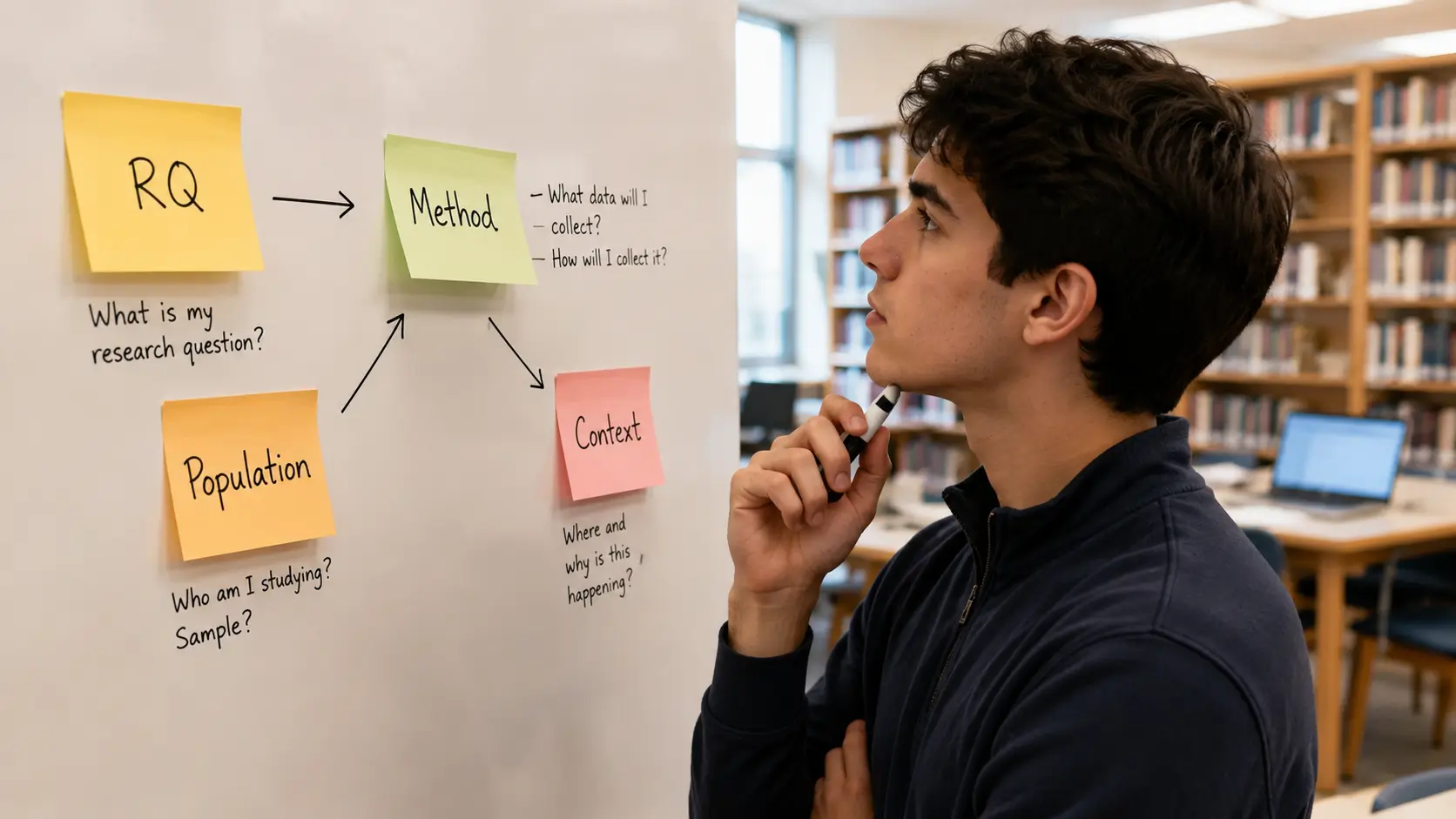
6. Crafting Your IB Psychology IA Research Question
A proposal-style RQ is specific, measurable, and contains your Approach, Concept, Population, and Context. Here are three examples we use when coaching at IB Psychology Academy:
Sample 1 (Interview Method)
Sample 2 (Experiment Method)
Sample 3 (Observation Method)
After every theory you mention, force yourself to ask: “So what? How does this actually affect a real teenager on a Tuesday afternoon?” If you cannot answer that, your context is missing. This single question fills the gap between dry theory and real-world application.
7. How to Structure Your Proposal
Follow this skeleton to ensure you hit every marking point without wasting words.
- Aim: Start with one clear sentence stating your research purpose.
- Background / Rationale: Briefly summarize 2–3 key theories/studies. Clearly state the “gap”—why has this not been studied exactly this way before?
- Research Method & Design: State your chosen method. Justify it: “An interview was chosen over an experiment because we are exploring subjective perceptions…”
- Participants: Describe your population of interest. Who are they? How will you sample them?
Could you walk into a local café and recruit 15 strangers for your IB Psychology IA study in under 15 minutes? If not, your study is too big. Examiners reward highly localized, realistic samples—like 15 students from your own grade. Keep it local, keep it precise.
- Procedure (Crucial for Criterion C): Write this like a recipe: Step 1, Step 2, Step 3.
If we handed your procedure to a 16-year-old stranger in another country at midnight, could they run your IB Psychology IA study without asking a single clarifying question? If the answer is “no,” your procedure is too vague. Write it so anyone could replicate it.
- Ethical Considerations: Tailor this to your study. Mention informed consent, right to withdraw, debriefing, and anonymization.
- Data Analysis Plan: Briefly mention if you will use thematic analysis (qualitative) or descriptive statistics (quantitative).
- Anticipated Limitations (Criterion D): Be brutally honest. “The use of self-reporting may introduce social desirability bias…”
8. From IB Psychology IA Examiner’s Desk: The 3 Traps to Avoid
Here at IB Psychology Academy, when we train our tutors, we emphasize these three pitfalls that consistently lose students marks on their IB Psychology IA.
Trap 1: Vague Procedures
If your procedure is vague (e.g., “I will ask them questions”), you lose marks. Specify where (quiet room), how long (20 minutes), and what questions (attach a sample schedule).
Trap 2: Unrealistic Scope
You are a high school student, not a global research institute. Do not propose a multi-continental study with 1,000 participants.
Examiners do not reward global ambitions; they reward local precision. Propose a study in one school, with one age group, in one specific context. That is a top-scorer’s move.
Trap 3: Predicting Exciting Results
Do not pretend you know the outcome before running the study. Instead, evaluate what your design cannot establish. For example: “As this is a qualitative interview, we cannot establish a causal correlation—only explore subjective meanings.” That kind of honest, methodological awareness gets top marks.
9. Quick Final IB Psychology IA Checklist
Before you submit your IB Psychology IA, run through this checklist:
- Does my RQ clearly state the Approach, Concept, Population, and Context?
- Have I explicitly justified why I chose my specific method?
- Is my procedure written in bullet points or numbered steps (so anyone could replicate it)?
- Are my ethical considerations tailored to my specific participants?
- Have I ruthlessly edited to ensure I am strictly under 2,200 words?
- Have I honestly critiqued my design—not predicted exciting results?
10. Still Feeling Stuck? Let Our Team Guide You
Writing a flawless IB Psychology IA proposal takes clarity and confidence.
If you are staring at a blank page or second-guessing your methodology, do not struggle alone. Our tutors at IB Psychology Academy specialize in breaking down the 2027 syllabus into simple, actionable steps. We offer one-on-one coaching to help you refine your RQ, structure your procedure, and polish your evaluation for a guaranteed top score on your IB Psychology IA.
IB Psychology Academy – Let us help you turn your IB Psychology IA proposal into a masterpiece.
Get the Right Support for IB Psychology IA
Whether you need help understanding Psychology concepts, preparing for examinations, or working on your IA, we can help you find the right tutor for your needs.
Speak with us about your requirements and take the first step towards personalised IB Psychology tutoring.
Tell Us How We Can Help
Complete the form and we will get back to you.